
Korean Glass Skin Goes Mainstream: Why K-Beauty Is Taking Over U.S. Beauty Shelves
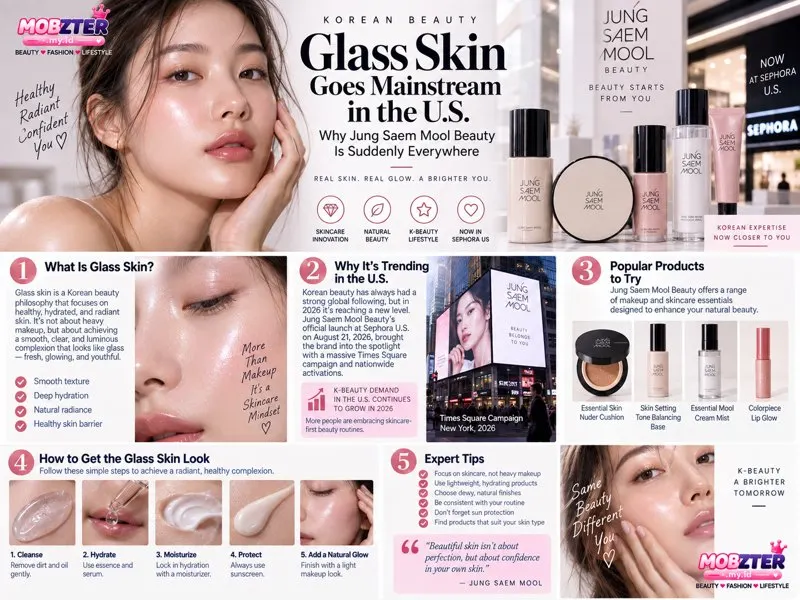
The clearest signal came in August. Korean makeup artistry brand Jung Saem Mool Beauty officially launched at Sephora in the United States on August 21, making its complexion products available on Sephora.com and at 34 stores. Just one day earlier, Sephora and South Korea’s CJ Olive Young brought a curated K-beauty edit of 19 brands to more than 500 U.S. Sephora stores and online.
American shoppers can increasingly discover Korean formulas beside established Western prestige brands instead of treating them as specialist imports.
Glass skin is becoming bigger than a viral look
“Glass skin” is usually used to describe a complexion that looks smooth, hydrated, translucent and naturally reflective. It does not literally mean poreless skin, and it should not be treated as a promise that normal texture will disappear.
The more useful way to understand the trend is as a skin-first beauty philosophy. Instead of covering the complexion with a heavy opaque layer, the visual goal is to build hydration, maintain a comfortable skin barrier and use makeup strategically so the skin still looks like skin.
Why Jung Saem Mool’s Sephora launch matters
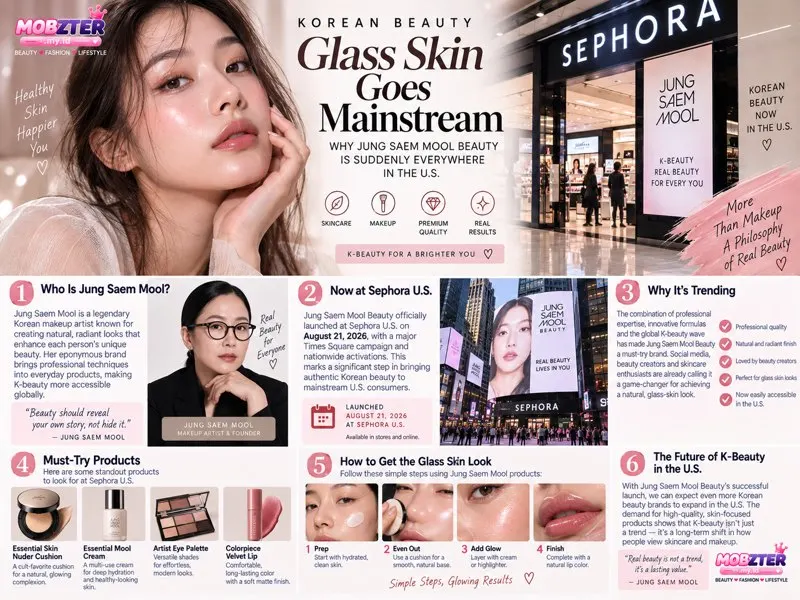
Jung Saem Mool is not simply another Korean skincare label entering America. The brand grew from professional makeup artistry, and its U.S. Sephora push centers on complexion products and the techniques behind the glass-skin aesthetic.
According to the brand’s August 28 announcement, Jung Saem Mool Beauty launched at Sephora on August 21, 2026, online and in 34 U.S. stores. The centerpiece is the Essential Skin Nuder Cushion with 10 Sephora-exclusive shades, extending the shade range from light tones through deeper shades including Mahogany, Deep, Rich and Ebony.
That last detail is important. Korean cushion foundations have historically faced a recurring challenge in Western markets: shade availability. A broader Sephora-specific range suggests that bringing K-beauty mainstream requires more than importing a bestseller unchanged. Products also have to make sense for the diversity of the market they are entering.
From Times Square to Los Angeles: this is more than a shelf launch
The brand is supporting the retail debut with a campaign designed to make Korean makeup artistry visible outside beauty feeds. Its Times Square program included digital placements around the Sephora flagship and subway station, followed by consumer giveaway activations in Manhattan.
The campaign is also moving west. A Sephora x Jung Saem Mool influencer master class is scheduled in Los Angeles for October 1, followed by a mobile pop-up at The Grove on October 3–4. The significance is not the billboards themselves; it is that a Korean complexion philosophy is being marketed as a mainstream U.S. beauty experience rather than an overseas curiosity.
The even bigger story: Olive Young is now inside Sephora
Jung Saem Mool is only one piece of a much larger shift. On August 20, Sephora and CJ Olive Young launched the OLIVE YOUNG K-Beauty Edit in more than 500 U.S. Sephora stores and on Sephora.com.
The initial curation contains 19 Korean brands selected around product performance, consumer popularity and trend leadership in Korea. Names include Abib, Arencia, BANILA CO, BIOHEAL BOH, Cell Fusion C, ma:nyo, REJURAN Cosmetics, SUNGBOON EDITOR, Torriden, WELLAGE and others.
For years, American K-beauty discovery was heavily shaped by social media, specialist e-commerce and viral products. The Sephora–Olive Young partnership gives a major Korean retailer a direct role in deciding which Korean trends and brands are introduced to mainstream U.S. shoppers.
Sephora’s Times Square flagship also has a dedicated Olive Young K-beauty space. The partnership is expected to expand into additional international markets, making the U.S. debut part of a wider global retail strategy.
Why America is ready for “Glass Skin 2.0”
The original glass-skin conversation could sometimes feel like a race to layer more products. The 2026 version is more practical. Consumers increasingly encounter hybrid products, barrier-focused formulas, toner pads, essences, ampoules, cushion foundations and lightweight creams — but the goal does not have to be a rigid ten-step routine.
Clean skin without chasing the squeaky-tight feeling.
Use a hydrating toner, essence or serum if your skin benefits from it.
Choose a moisturizer appropriate for your skin type and climate.
Use appropriate daytime sun protection rather than relying on glow products.
Apply complexion makeup in thin layers and add luminosity where wanted.
You do not need ten products to get the idea
This is where beginners can save money. “Korean skincare” is not a requirement to buy every category at once. A simple routine can still borrow the philosophy: gentle cleansing, adequate moisture, sun protection and makeup that works with the condition of your skin.
If your current cleanser, moisturizer and sunscreen already work well, there is no reason to replace them simply because a new trend has arrived. Add one new product at a time. That makes it easier to notice whether your skin actually likes it and avoids turning a beauty trend into an expensive experiment.
Dry-feeling skin: look first at hydration and barrier support.
Heavy makeup wearer: a cleansing balm or oil may be the more useful entry point.
Interested in glass-skin makeup: explore thin complexion layers or a cushion rather than automatically adding more skincare.
Sensitive or reactive skin: keep the routine simple, check ingredients and patch-test new products.
Why Korean beauty translates so well to social media
K-beauty has several advantages in a short-form-video world. Texture is easy to demonstrate. Toner pads, jelly formulas, cushion compacts, cleansing balms and glossy essences create immediate visual transformations. Packaging is often distinctive, while routines naturally lend themselves to before-and-after storytelling.
But social virality alone does not explain the current expansion. The Sephora–Olive Young partnership matters precisely because it adds physical retail infrastructure to that digital demand. A shopper who sees an unfamiliar Korean product on TikTok can increasingly test, return or repurchase it through a retailer they already know.
Glass skin is also changing makeup
The most interesting evolution may be the collapse of the old boundary between skincare and complexion makeup. Cushion foundations are a perfect example: the application method encourages thin, controlled layers, while the desired finish often prioritizes dimension and radiance over a completely flat surface.
Jung Saem Mool’s approach fits this shift especially well because the brand is rooted in makeup artistry. “Glass skin” here is not simply serum plus moisturizer; it is also about how base makeup is placed, how much natural dimension remains visible and how highlights interact with the face.
A long routine was often treated as part of the identity of K-beauty.
Fewer well-chosen steps can be more practical than collecting every trending product.
What U.S. beauty shoppers should watch next
Watch the products that sit between categories. Korean beauty has long experimented with formats that blur familiar Western labels: skincare-infused complexion products, toner pads, multi-use balms, ampoules, sophisticated cleansing textures and home beauty devices.
Also watch which brands become repeat purchases after the launch excitement fades. A viral video can create a sellout; mainstream adoption is different. It happens when shoppers understand what a product does, can find it easily and decide it deserves a permanent place in their routine.
The takeaway
Korean beauty did not suddenly appear in America in 2026. U.S. beauty fans have been buying Korean products for years. What is changing is the scale, visibility and retail pathway.
Jung Saem Mool Beauty bringing its glass-skin complexion philosophy to Sephora, while Olive Young simultaneously curates 19 Korean brands for more than 500 Sephora stores, makes August 2026 feel like a marker in that evolution. K-beauty is no longer only influencing what Americans search for online. It is increasingly influencing what they see when they walk into a mainstream beauty store.
And perhaps that is the most useful version of glass skin yet: not a promise of perfection, but a broader beauty shift toward hydration, thoughtful layering, lighter-looking complexion makeup and skin that is allowed to look alive.



Comments
Post a Comment