
How to Use Google Ads AI Max Without Wasting Your Budget: A Beginner’s Guide

Mobzter illustration: a beginner-friendly visual guide to testing Google Ads AI Max without losing budget control.
If you are new to Google Ads, AI Max can sound like the kind of feature that makes advertising easier: switch on more automation, let Google find additional searches, and wait for more customers. The problem is that automation can also spend money very efficiently on the wrong goal if your campaign is not ready.
The safer approach is not to give AI Max a budget and hope for the best. Start with clean conversion tracking, a useful landing page, sensible campaign goals, and a controlled experiment. Then let the numbers decide whether AI Max deserves a bigger role in your account.
What AI Max actually changes in a Search campaign
AI Max for Search adds AI-powered capabilities around search term matching and asset optimization. Depending on the settings you use, it can help a campaign reach relevant searches beyond the terms you would normally target, customize ad text, and direct users toward a more relevant page on your website.
That can be useful, especially when customers describe the same need in many different ways. But broader discovery also makes measurement more important. A campaign that counts weak actions as conversions can teach an automated system to chase those weak actions.
1. Fix conversion tracking before touching AI Max
Before testing AI Max, decide what a successful click actually means for your business. For an online store that may be a completed purchase. For a service business it could be a qualified lead, appointment, or phone call. Newsletter sign-ups or other micro-actions may still be useful, but they should not automatically be treated as equal to revenue-generating actions.
This is especially important when using value-based bidding. Google states that Maximize conversion value requires conversion tracking with transaction-specific values. In other words, the AI needs a useful signal before it can optimize around value.
2. Do not start with a budget you cannot afford to learn with
There is no universal “perfect” daily budget for AI Max. A local service business and an international ecommerce store have completely different economics. Instead, work backwards from what a customer is worth and what you can realistically afford to pay to acquire one.
Your acceptable acquisition cost should guide your budget and bidding decisions—not excitement about a new AI feature.
Also remember how automated bidding behaves. Google says Maximize conversions aims to use the budget available to generate as many conversions as possible, so moving a campaign to a more automated strategy can materially change spending behavior. Treat your daily budget as a real spending control, not a suggestion you expect the system to ignore.
3. Give the AI a landing page worth sending people to
AI Max cannot rescue a confusing website. Before expanding traffic, open the landing page on a phone and pretend you know nothing about the business. Can you understand the offer within a few seconds? Is the price or next step clear? Does the page load properly? Is there an obvious way to buy, call, book, or request information?
Final URL expansion can help Google find a more relevant destination on your site, but that becomes much more useful when the site itself has clear pages with accurate titles, useful copy, and distinct intent.
Improve the pages receiving those clicks. Better traffic sent to a weak page is still a weak advertising setup.
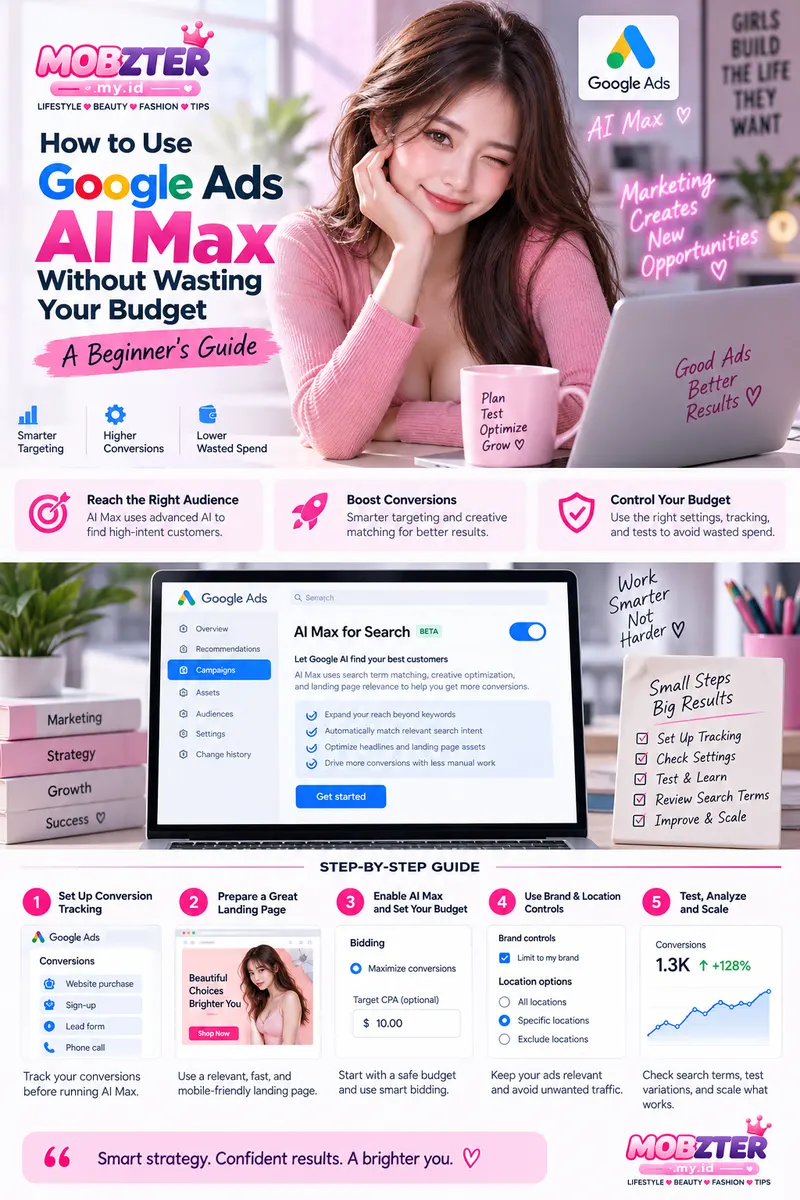
Mobzter visual guide: a simple AI Max workflow from conversion tracking and landing-page preparation to testing and scaling.
4. Use the controls instead of treating AI Max as an all-or-nothing switch
AI Max includes granular controls. In Google's experiment setup, advertisers can configure features such as text customization and Final URL expansion, as well as brand inclusions and exclusions. That means testing AI does not require abandoning every campaign boundary.
Brand controls are particularly useful when branded searches could distort your results. Someone already searching specifically for your company can behave very differently from a new customer discovering you through a generic commercial search.
5. Run an AI Max experiment before rolling it out everywhere
This is one of the best safeguards available to beginners. Google provides dedicated AI Max experiments for eligible Search campaigns. Instead of creating a completely separate copy of the campaign, the experiment can divide the existing campaign between a control with AI Max off and a trial with AI Max on.
Google's current AI Max experiment flow can test search term matching and asset optimization while keeping the test within the existing campaign. If the result is favorable, you can apply the experiment. If it is not, you have learned something without blindly changing every campaign.
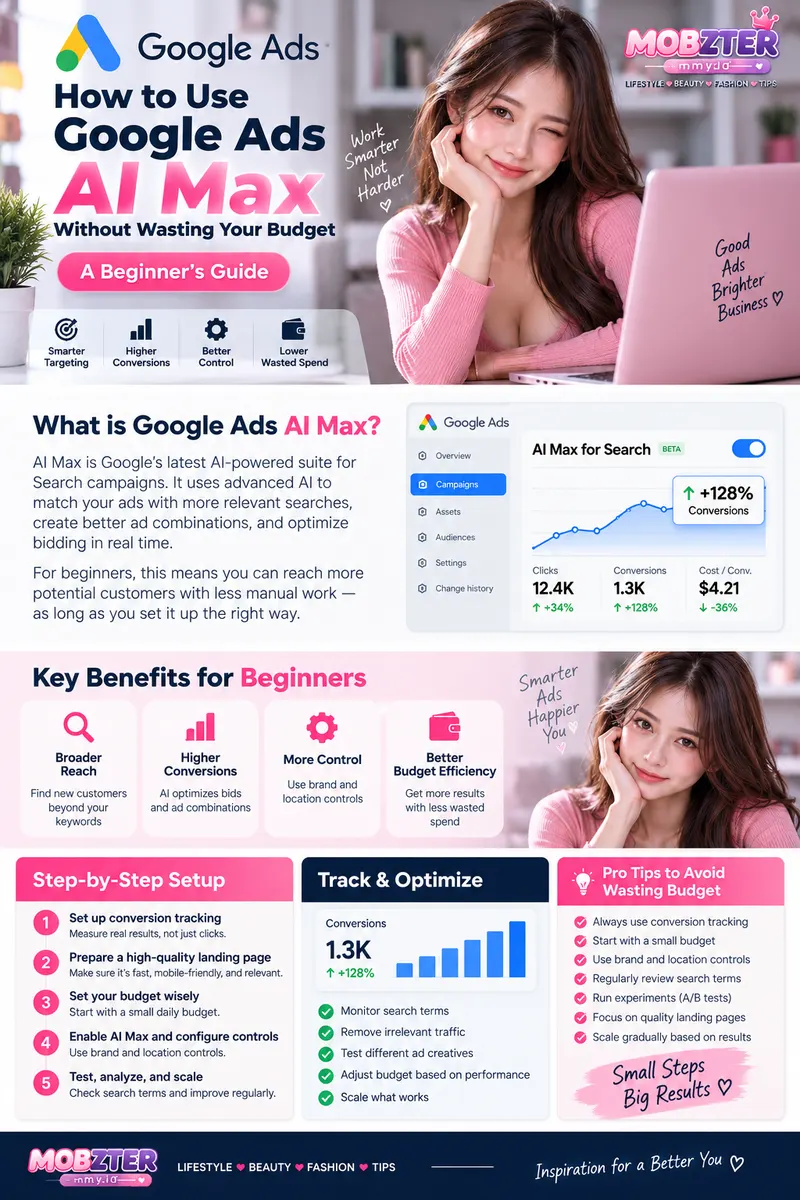
Mobzter illustration: track, test and optimize before increasing spend. AI Max works best when the campaign has reliable data and clear controls.
6. Judge the test by business results, not exciting traffic numbers
A jump in impressions can look impressive. More clicks can feel like progress. Neither automatically means the campaign is making more money.
Choose the metric that matches the business goal. Lead-generation campaigns may care about qualified conversions and cost per acquisition. Ecommerce businesses may care more about conversion value and return on ad spend. If the AI Max trial generates more traffic but produces worse economics, the extra traffic is not the win it appears to be.
7. Give the experiment enough time
A common beginner mistake is changing settings every few days. That makes it difficult to know which change actually caused the result. Google's general experiment guidance recommends allowing tests enough time to collect meaningful data; some experiment guidance suggests at least four to six weeks when results remain undecided, with longer periods potentially needed when conversion delays are long.
The exact amount of time your campaign needs depends on traffic and conversion volume. A campaign generating many conversions every day can learn differently from a small account receiving only a few leads each month.
8. Watch what the automation is learning
Automation should reduce repetitive work, not remove the advertiser from the decision-making process. Review the search behavior, conversion quality, landing pages, ad messaging, geographic performance, and cost trends regularly.
If leads suddenly increase, ask whether they are good leads. If conversion value rises, check whether profit follows. If AI-generated or customized messaging appears, make sure it still represents the business accurately.
If the conversion action is too easy, duplicated, low quality, or incorrectly configured, an automated campaign may optimize toward the wrong signal.
When should a beginner test AI Max?
AI Max makes the most sense when your Search campaign already has a clear business goal, reliable conversion measurement, usable landing pages, and enough activity to evaluate a test. It can also be useful when you suspect customers are searching in ways your existing keyword setup does not fully capture.
You may want to wait if tracking is broken, your website is unfinished, you do not know which conversions are valuable, or your budget is so tight that even a short learning period would create unacceptable risk.
A safer beginner workflow
AI Max is a tool, not a substitute for marketing judgment
The useful part of AI Max is not that it removes the need to understand advertising. It can help Google Search campaigns discover additional opportunities and automate pieces of matching and asset optimization, while experiments give advertisers a practical way to test the effect.
For a beginner, that makes the safest strategy surprisingly simple: measure first, test second, scale third. If the numbers show that AI Max produces better business results at an acceptable cost, keep it. If they do not, the experiment has done its job before a larger budget was put at risk.



Comments
Post a Comment