
Google Ads Is Changing: What Is AI Max and What Does It Mean for Online Businesses?
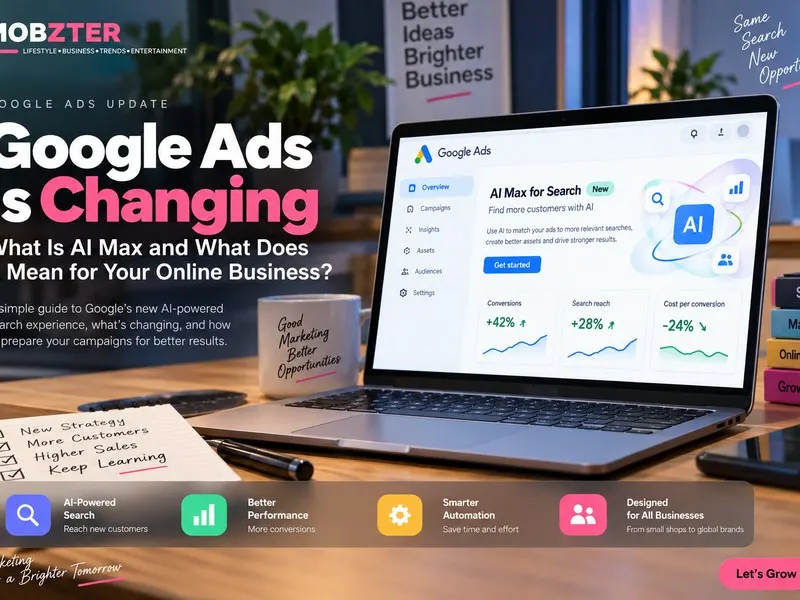
If you run Google Ads for a small business, an online store, or even your own side project, you may have noticed a new name appearing more often inside Google's advertising ecosystem: AI Max for Search campaigns. It sounds like another AI feature to learn, but this one matters because Google is gradually moving some familiar Search campaign features into it.
The good news is that you do not need to rebuild your entire advertising strategy overnight. The more useful question is simpler: what is AI Max actually doing, and what should you check before letting it make more decisions for your campaigns?
It is a set of AI-powered targeting and creative enhancements for existing Search campaigns. Google says it can expand the searches you reach, adapt ad text and direct visitors to more relevant pages while still providing advertiser controls.
First, what exactly is AI Max?
Think about a traditional Search campaign. You choose keywords, write ads, choose landing pages and tell Google how much you are willing to pay for the results you want. AI Max does not throw that foundation away. Instead, it adds another layer of automation around it.
Google describes AI Max as a suite of targeting and creative enhancements for Search campaigns. Its search term matching can use your existing keywords together with broader and keywordless technology to discover relevant searches you might not have targeted manually.
On the creative side, text customization can generate or adapt text assets using information from your landing pages, existing ads and keywords. Final URL expansion can also send someone to a page on your site that Google considers more relevant to that person's search.
Why is everyone suddenly talking about it?
Because the transition is no longer theoretical. Google says AI Max for Search has moved out of beta, and eligible campaigns using Automatically Created Assets (ACA) or the campaign-level broad match setting are scheduled to begin automatically upgrading to AI Max starting in September.
There is an important detail here. Google's original announcement also discussed Dynamic Search Ads moving in September, but Google later updated the timeline: the DSA sunset and automatic upgrade is now scheduled to begin in February 2027. ACA and campaign-level broad match upgrades are still proceeding from September 2026.
If you manage an older Search account, do not assume every legacy feature changes on exactly the same day. Check which feature your campaign actually uses before changing anything.
Does AI Max mean keywords are dead?
No. This is probably the easiest misunderstanding to make.
Your existing keywords are still useful signals. What changes is that Google can go beyond the literal keyword list when its systems find a search that appears relevant to your business. In practice, this means the job is shifting from endlessly adding every possible keyword variation toward giving Google better inputs and then checking whether the resulting traffic is actually valuable.
For a small advertiser, that makes your landing pages, conversion tracking, negative keywords, brand controls and campaign goals more important—not less important.
A simple example: imagine you sell handmade leather bags
Suppose your campaign contains keywords around “handmade leather bag” and “leather work bag.” A potential customer might search using a longer phrase you never added manually, such as a very specific description of the bag they need.
AI Max can use signals from your keywords, ads and website to decide whether that search is relevant. It may also customize the ad messaging and, when final URL expansion is enabled, select a more suitable page on your site.
That sounds convenient—and it can be. But if your website has weak category pages, outdated offers or pages that should never receive paid traffic, giving an automated system more freedom can expose those weaknesses very quickly.
So, should a small business turn everything on?
I would not treat AI Max like a magic switch. Treat it like a new employee who can work incredibly fast but still needs clear instructions and measurable goals.
If Google cannot reliably tell a sale, lead or valuable action from an ordinary visit, more automation does not solve the underlying problem.
Make sure product, service and category pages are accurate, useful and appropriate destinations for paid traffic.
Review brand and location controls when they matter to your business. AI Max includes controls designed to help advertisers steer where automation operates.
Extra reach is valuable only when it brings people who could realistically become customers.
Google now provides AI Max experiments, and new testing tools are rolling out that can compare budget and ROI target changes across multiple Search campaigns.
What does Google say about performance?
Google reports that Search campaigns already using AI Max search term matching saw an average 7% more conversions or conversion value at a similar CPA/ROAS when text customization and final URL expansion were also enabled. That figure comes from Google's own internal 2026 data for non-retail advertisers, so it is useful context rather than a promise that every account will gain 7%.
Your results can be very different depending on the business, website, market, tracking quality, bidding strategy and existing campaign structure. If your current campaign is already tightly optimized, the impact may look different from an account with large gaps in keyword coverage.
The part marketers should pay attention to: control
The interesting story is not simply “Google uses more AI.” That has been happening for years. The more important question is how much control advertisers retain while the system becomes more automated.
AI Max includes controls for areas such as brands and locations, along with reporting intended to show what the system is doing. Google has also expanded its experiment tools so advertisers can test AI Max while keeping certain brand or location guardrails in place.
That makes experimentation a much healthier approach than blindly switching everything on—or refusing to use automation at all.
If you open Google Ads today, what should you do?
Do not start by changing ten settings at once. Open the Search campaigns that actually generate meaningful leads or sales and document their current performance. Check whether ACA, campaign-level broad match or DSA is being used. Then inspect your conversion actions, landing pages and search terms.
If AI Max is available in your account, use an experiment where practical. Give the test enough clean data to be useful and compare business outcomes—not vanity metrics. A campaign getting more clicks is not automatically a better campaign if those visitors do not buy, enquire or complete the action you care about.
AI Max changes the workflow, not the goal
Online advertising has always been about finding the right customer at a cost the business can afford. AI Max changes more of the machinery behind that process, but it does not change the basic economics. Give the system good data, keep sensible guardrails, test changes carefully and judge it by real business results.


Comments
Post a Comment