
AI Influencers Are Everywhere — Instagram Now Wants You to Know Which Ones Aren’t Real
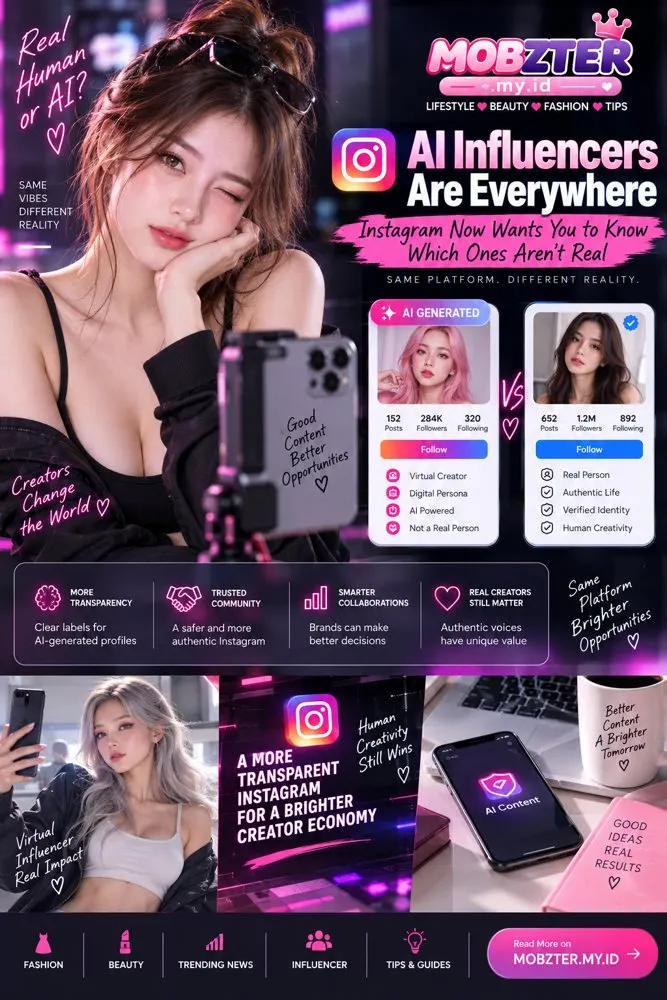
Mobzter illustration: the line between a human influencer and a synthetic persona is becoming harder to spot at a glance.
Scroll through Instagram quickly enough and you may eventually stop asking whether the person on screen is a model, creator, heavily edited photograph or someone who never existed at all. Virtual personalities can now look convincing enough to fit naturally beside fashion creators, beauty accounts and lifestyle influencers.
Instagram is responding with a clearer signal. The platform is renaming its earlier “AI creator” label to “AI-generated profile” for accounts built around an AI-generated person. More importantly, profiles that feature an AI-generated person but fail to disclose it can have their recommendation reach limited.
Why Instagram changed the wording
“AI creator” could be interpreted in more than one way. It might describe a human creator who simply uses AI for editing, captions or graphics. “AI-generated profile” is much harder to misunderstand: it tells viewers that the person at the center of the account was generated or substantially created with AI.
Instagram says people do not like discovering later that a profile they assumed was human actually featured an AI-generated person. The change is therefore less about banning synthetic creators and more about making the identity of the account clearer from the beginning.
Unlabeled AI profiles can lose recommendation reach
This is where the update becomes more than a cosmetic badge. Instagram says accounts featuring an AI-generated person without the appropriate disclosure may be recommended to fewer people. A creator who proactively uses the label should not lose reach simply because the profile features an AI-generated person.
That creates a straightforward trade-off for virtual-influencer operators: transparency preserves the opportunity to participate in recommendations, while trying to pass a synthetic personality off as a human can reduce discovery.
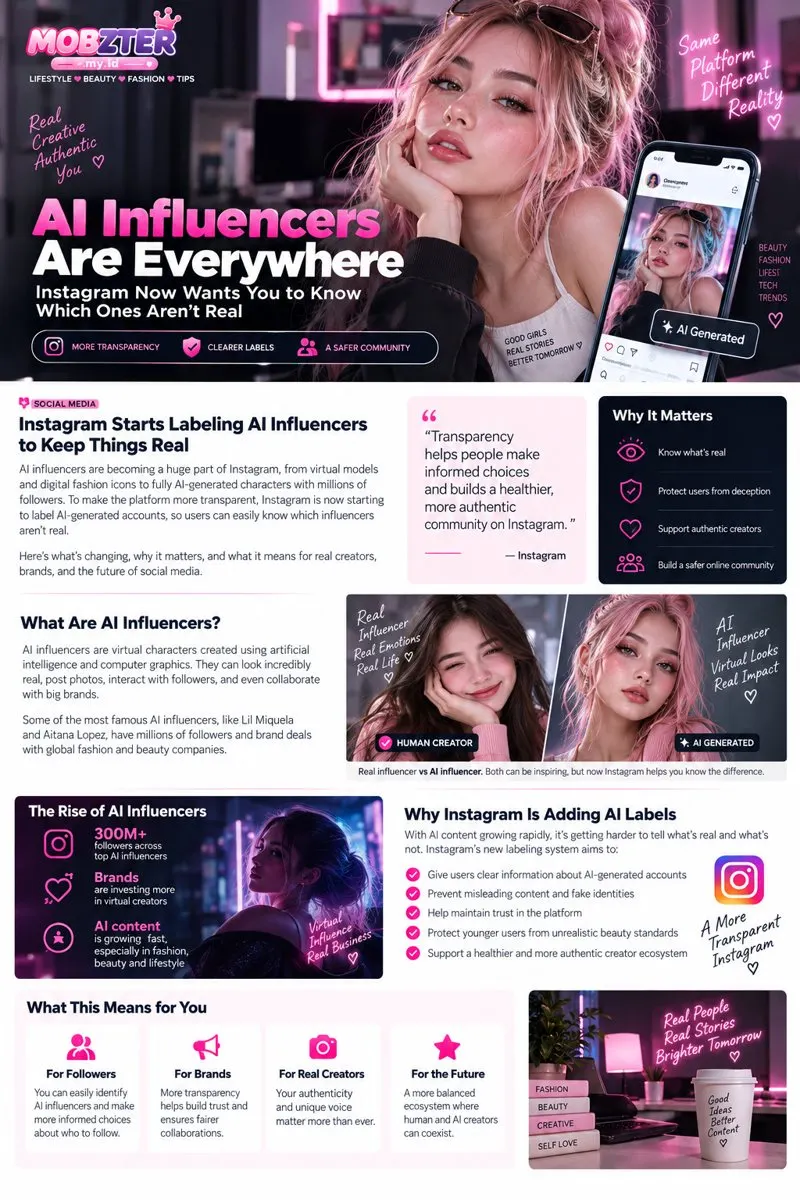
Mobzter visual guide: clearer identity disclosure gives followers and brands more context before they engage with a creator.
This does not mean every use of AI needs the profile label
The distinction matters. Instagram's new profile designation is aimed at accounts whose featured person is AI-generated. A human influencer does not suddenly become an “AI-generated profile” because she used an AI tool to clean up a graphic, help draft a caption or make another creative adjustment.
Meta has separately developed content-level AI disclosures for generated or substantially altered media. The profile label addresses a different question: is the personality you are following itself an AI-generated person?
Why this matters for fashion and beauty followers
Fashion and beauty are particularly interesting places for virtual creators because the visual language is already highly polished. Perfect lighting, retouching, carefully staged outfits and aspirational lifestyles have been part of influencer culture for years. Generative AI can push that polish further by creating a face, body, wardrobe and environment from scratch.
That context matters when people compare themselves with creators online. A synthetic body does not have the physical limitations of a human body, and a virtual wardrobe does not need to fit, wrinkle or even physically exist. Transparency will not eliminate unrealistic imagery, but it gives viewers one more piece of information with which to interpret it.
For brands, AI influencers create a new due-diligence question
Brands have long checked audience quality, engagement, demographics and reputation before paying an influencer. Synthetic personalities add another question: what exactly is the brand partnering with?
A disclosed virtual creator can still have an audience, recognizable aesthetic and commercial value. But brands need to understand how the persona is produced, who controls it, whether the audience understands its synthetic nature and whether that positioning fits the brand's own promise of authenticity.
Real influencers may actually gain something from clearer AI labels
The rise of virtual creators does not automatically mean human influencers become obsolete. In fact, clearer disclosure can make the difference between the two more meaningful.
A human creator can offer lived experience: how shoes actually feel after several hours, how a beauty product behaves on real skin, what happened during a trip, or why a business decision failed. AI can simulate the appearance of those experiences, but it does not personally live them.
That makes personality, credibility and genuine experience more valuable rather than less. It also fits a broader shift in social media toward content that feels less over-produced and more connected to a real community.
There is still a problem: AI labels are not perfect
Transparency systems themselves can create confusion. Recent reporting has shown Instagram's content-level AI detection sometimes labeling images that received relatively minor AI-assisted edits, while some genuinely generated material can escape automatic detection. That is a reminder that a label is useful context, not a flawless lie detector.
The new profile designation is easier to understand conceptually because it focuses on the identity presented by the account rather than trying to measure every editing operation behind an individual photograph.
So, how can you tell what you are following?
AI influencers are not disappearing — they are becoming easier to identify
Instagram's move does not close the door on virtual personalities. It effectively gives them a clearer lane: be creative, build an audience and work with brands, but do not depend on people mistaking an invented person for a real one.
For followers, that is useful. For brands, it adds context. And for human creators, it reinforces something algorithms cannot manufacture quite as easily as an image: a real history, real experiences and a relationship with an audience built around an actual person.


Comments
Post a Comment